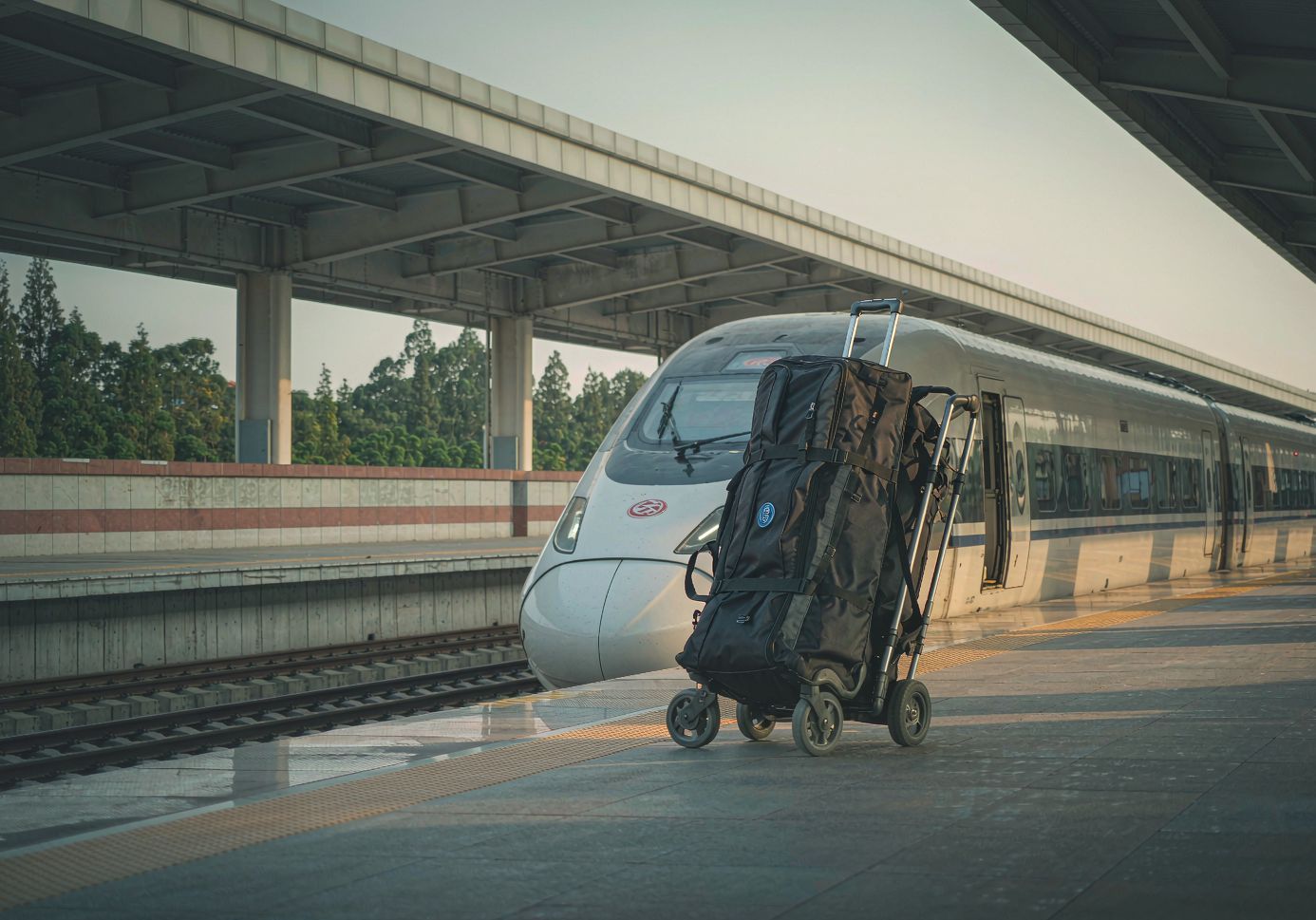
The clubs are the trip's most faithful companion and its most awkward luggage. China is actually one of the easier countries to travel with a golf bag — airlines know what one is, trains take them, and courses will store them between rounds — but the details are worth ten minutes of reading before you fly, because a mishandled travel day costs a round.
This guide covers the three environments your bag will live in — the long-haul flight, the domestic hop, and the high-speed train — plus the storage-and-transfer choreography that makes a two-region trip work with one bag.
The long-haul flight
Every major carrier flying into China — the Chinese flag carriers and the internationals alike — accepts a golf travel bag as checked luggage. The two things that determine whether it is smooth or expensive:
- **How it counts** — most carriers count a golf bag (with clubs inside, up to ~15 kg) as one piece of checked baggage under your allowance; some sell it as a "sports equipment" piece at a fixed fee. Check your fare's piece allowance before you assume.
- **How it is packed** — a hard case survives anything but eats your luggage scale; a good padded soft travel bag with a stiff arm protector is the local optimum and what most travelling golfers use. Clubs, shoes, a dozen balls and a rain shell fit inside 15 kg without trying.
Put a printed copy of your itinerary — with your first hotel in Chinese — inside the travel bag, and an AirTag or similar tracker in the side pocket. Delayed bags in China are rare and efficiently returned, but they are returned to addresses, and a bag that knows where it is going arrives a day sooner.
The domestic leg
Internal flights (Shanghai–Sanya, Chengdu–Beijing, and friends) treat the golf bag the same way — one sports-bag piece — with two China-specific notes. First, security screening is thorough but golf clubs are routine; nothing in a normal bag attracts a second look except rangefinder batteries, which fly fine inside the device. Second, domestic aircraft fill their holds, and a full flight with an oversold baggage hold is the one scenario where a golf bag occasionally travels on the next plane. On transfer days we build the schedule so a bag arriving two hours late costs nobody a tee time.
The alternative that most multi-region trips eventually use: send the bag ahead. Same-day and overnight intercity courier of a golf bag inside China is inexpensive (~US$15–30) and reliably safe between our partner courses and hotels. On a Yunnan-plus-Hainan combination, your clubs can fly cargo while you fly comfort — we arrange it end to end.
The high-speed train, with a golf bag
Yes, you can take a golf travel bag on a Chinese high-speed train, and thousands of golfers do it every week. The rules are practical rather than formal: the bag must fit through the wide doors and the luggage racks are sized for suitcases, so a soft travel bag goes either in the oversize luggage racks at carriage ends (every train has them) or, on many services, behind the last row of seats. A hard-shell case is a genuine nuisance on trains — heavy, rigid, and awkward in a moving aisle. This is the strongest argument for soft travel bags in China, full stop.
- First class and business class give you more floor space and calmer boarding; second class works fine midweek when the train is not heaving.
- Avoid the departure rush: stations are vast, and walking 600 metres with a 15 kg bag is a 12-minute proposition. Arrive 45 minutes early, not 20.
- Escalators are everywhere, lifts are findable but occasionally hidden; station staff will point, and porters exist at major stations for a few dollars.
- On a full train — Friday afternoons, holiday eves — a golf bag makes you unpopular. This is the one case where the courier-ahead option beats riding with your clubs.
The train rides themselves are the best travel in Asia at any price: 350 km/h, spotless, on time to the minute, phone signal the whole way. Shanghai to Hangzhou is under an hour; the Jiangnan circuit (Suzhou, Nanjing, Hangzhou) is a golf trip stitched together by train timetables. See our payments guide for buying tickets — they open about two weeks out, and we buy them the minute they do.
The honest case for renting
Rental sets at Chinese resorts are better than the region's reputation suggests: recent-model Callaway, TaylorMade and Honma sets circulate at five-star golf resorts, maintained by staff who check lofts and grips daily. Rental with shoes runs about US$40–80 per round. Renting wins in three real situations:
- You are combining golf with city travel where a bag is dead weight for half the days.
- Your trip includes a train-heavy Jiangnan week where you would rather not manage the bag through five stations.
- You want to try the Japanese-market shafts and Honma builds that Asian clubhouses stock — a quiet pleasure of golf here.
Bring your own when the trip is golf-first and single-region: your gamer earns its airfare on the first approach shot. A hybrid also works — your driver and putter in a small carry bag, rented irons on site — and yes, caddies happily manage the mix.
The train does not mind your golf bag. It minds your hard case. Pack soft, ride happy.
Asked before you ask.
Yes — virtually every resort course and most daily-fee clubs store bags overnight or for days, free or for a token fee, tagged and indoors. Many golfers check into a resort, hand the bag to the caddie master, and never touch a luggage trolley again.
The 15–18 kg mark is where some carriers re-classify a golf bag from "sports equipment" to "overweight piece" with a fee. One set, no ball fort, no shoe army, and you stay under.
Lithium batteries under 100Wh fly in the cabin with you; installed in a trolley in the hold they are refused by most Chinese carriers. Leave the electric trolley home — carts and caddies make it redundant in China anyway.
Where this applies.
THE JOURNEYS THIS SHAPES
KEEP READING
GO DEEPER